Table of Contents
- What is the Main Purpose of a Drogue Parachute?
- How Does a Drogue Parachute Work?
- Why is a Drogue Chute Necessary for a Tandem Skydive?
- What the Drogue Feels Like as a Tandem Student
- Drogue Parachute Design: How It Differs From a Main Canopy
- Drogue Parachutes Beyond Skydiving
Key Takeaways
A drogue parachute is a small, specialized canopy used in tandem skydiving to create drag, help stabilize the tandem pair, and assist with deploying the main parachute. The instructor deploys it during freefall, where it helps regulate the pair’s descent before the main canopy opens. Unlike a main parachute, a drogue is not designed to support a controlled descent to the landing area. Its compact design and aerodynamic function make it an important part of the tandem skydiving system.
When you picture a tandem skydive, you probably think of the airplane exit, the rush of freefall, and the moment the parachute opens above you. But have you ever wondered what happens between those moments? One small but essential piece of equipment helps make that transition possible: the drogue parachute.
Designed to create drag, help stabilize freefall, and assist with main parachute deployment, the drogue plays a unique role in tandem skydiving. So, how does a drogue parachute work, and why is it necessary when two people jump together? Let’s take a closer look at the design, mechanics, and purpose behind this important piece of skydiving equipment.
What is the Main Purpose of a Drogue Parachute?
A drogue parachute, also called a drogue chute, is a small parachute designed to create aerodynamic drag. Rather than supporting a person during the descent to the ground, it interacts with the airflow to influence speed, stability, or the deployment of a larger parachute.
In tandem skydiving, the drogue serves all three functions in a coordinated system. It helps manage the freefall speed of two connected people, contributes to a stable flying position, and provides the force needed to extract the main parachute deployment system.
As you move through the air, the air pushes back against you. This resistance is called drag. A drogue increases that resistance by catching the airflow with its fabric canopy. A simple concept, but it makes a meaningful difference when two people are connected together during a tandem jump.
Although a drogue resembles a miniature parachute, its job is quite different from that of the main canopy. Each component has a specific purpose within the overall system.
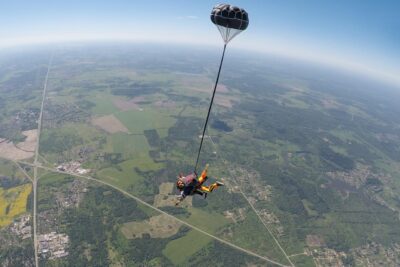
How Does a Drogue Parachute Work?
During a tandem skydive, a student and an experienced instructor are connected by a harness system. Because the pair has a greater combined mass than a solo skydiver, the parachute system must account for the aerodynamic and deployment requirements of carrying two people. The drogue helps manage those requirements throughout freefall. Here’s how the process works.
Drogue Chute Deployment: When and Who
After exiting the airplane, the tandem instructor deploys the drogue according to the equipment manufacturer’s procedures. The small canopy leaves its pouch, catches the airflow, and inflates behind the pair.
A connecting line called a bridle links the drogue to the parachute system. Once the drogue catches the air, it begins generating drag.
For the tandem student, there’s nothing to pull or deploy at this stage. The instructor handles the procedure, while the student can focus on the experience of being up in the sky.
Slowing and Stabilizing Freefall
As the drogue catches air, it helps regulate the tandem pair’s freefall speed and contributes to a stable body position. This works through the relationship between gravity and air resistance. Gravity accelerates the pair downward, while drag acts against their movement. As these forces balance, the descent approaches a steady speed known as terminal velocity.
The drogue influences this balance, helping the tandem system maintain its intended freefall characteristics.
Pulling Out the Main Parachute
The drogue also helps initiate main parachute deployment. When the instructor activates the deployment sequence, the inflated drogue creates tension through the bridle. This force helps extract the deployment bag containing the folded main canopy from its container, allowing the main parachute to deploy and inflate.
Unlike many solo skydiving systems, which typically use a pilot chute to initiate main parachute deployment, tandem systems use a drogue for this function.
Why is a Drogue Chute Necessary for a Tandem Skydive?
Why not skip the drogue and deploy the main parachute directly?
Tandem equipment is designed to accommodate two connected people, whose combined mass and aerodynamic characteristics influence their freefall. The main parachute also has specific deployment requirements that the system must account for.
The drogue helps meet these requirements by managing drag during freefall and providing the force needed to extract the main canopy. It is an integral part of the tandem system, not simply an extra piece of equipment.
What the Drogue Feels Like as a Tandem Student
Will you notice when the drogue deploys? You might feel a change in the airflow or the sensation of your descent or you might not notice anything – although the experience varies from person to person.
Freefall can also feel different from what movies suggest. Many skydivers describe the sensation as floating on a powerful cushion of air rather than simply dropping straight down. When the main parachute opens, you’ll experience a distinct change in movement as the canopy inflates and begins supporting you and your instructor.
Drogue Parachute Design: How It Differs From a Main Canopy
Although both devices use fabric and airflow, their designs reflect different purposes.
A drogue typically consists of lightweight parachute fabric connected to the system by a bridle. Its compact design allows it to catch the airflow and generate the required drag.
The main canopy has a much larger surface area and is engineered to support the skydiver or tandem pair during descent. Its shape, suspension lines, and control system determine how it flies.
In short, the drogue helps manage freefall and initiate deployment; the main canopy takes over for the descent to the landing area.

Drogue Parachutes Beyond Skydiving
Drogue parachutes also have applications in aviation and aerospace. Depending on the system, they can help stabilize an aircraft, assist with deploying a larger recovery parachute, or contribute to deceleration.
Some aerospace vehicles use smaller parachutes to stabilize their descent or prepare for a larger parachute deployment. Although the equipment varies, the underlying principle remains the same: use aerodynamic drag to influence movement or help deploy another system.
Ready to See a Drogue Chute Up Close?
You’ve learned how it works. Now it’s time to experience the thrill for yourself! Feel the rush of freefall, take in incredible views, and make a memory you’ll be talking about for years to come. The sky is calling, and Skydive Monroe is ready to help you make your dreams of flying come true. Book your tandem skydive today and get ready for an adventure unlike any other. Blue skies!
Categories:
Copyright © 2026, Skydive Monroe, All Rights Reserved.
DropZone Web Design & Marketing by Beyond Marketing, LLC